We clocked up approximately 300km today and crossed from the Eastern Bay of Plenty region into the Gisborne region. The weather was changeable, some of the roads in a really bad way but the scenery pretty beautiful.
We both commented on how green it is in this part of Godzone Aotearoa New Zealand compared to the Wonderful Waikato which is very dusty, dry and drought-brown.
Before leaving our campsite (I didn’t get my bike ride along the Motu Trail like I had hoped for) we chatted with a couple of Aucklanders who had an A-Class Dethleffs motorhome. We asked them why they chose the A-Class vs C-Class and what they thought of it.
Why? They liked the driving aspect of it – there’s more light (apparently). When I asked whether she also drove it, she screwed her face up, looked at him, and then vehemently shook her head. I kinda got the impression he might quite like her to do some driving.
Their bikes were on the back, under bike covers. As Alan said today as we were driving through filthy wet roads, we’re pleased our bikes are inside – dry and clean.
What I did notice, was that if you’re prepared to put in the effort and pack everything, there’s obviously no excuse for not looking as glam whilst camping as you are when you’re living in your Auckland apartment. This woman was absolutely stunning and I felt rather shabby beside her.
Late Lunch at the Kai Kart – Te Araroa
Alan had read somewhere that the Kai Kart in Te Araroa (SHW35) was touted to cook the best F&C in New Zealand. I’m not sure I’d go so far as to say it was the best, but it was pretty damn good.
What sort of fish could you choose from? Hoki. Hoki. Or Hoki. A bit like Henry Ford’s black. Black. Or black (Model T Car colour choice).
There’s nothing flash about the Kai Kart – the flooring was duct-taped together lumps of old-fashioned lino but the service was welcoming, polite and the coffee was good.
Yes – we’d dine again the next time we’re in this part of the country.


Sooo many colours of Toe Toe
Until today – seeing lots of clusters of Toe Toe together, I didn’t realise just how many different shades there were – almost as many colours as I saw alpacas on Sunday!
Toe Toe
Toe toe (sometimes incorrectly misspelled “toi toi”) is New Zealand’s largest native tussock grass, and very symbolic of New Zealand. There are five species endemic to NZ which are known for their tall, fluffy seed heads. These are often found in diverse habitats like sand dunes and wetlands.

“… Please be careful when opening overhead lockers as luggage may have moved during the flight…“
While Alan was finishing off his caramel milkshake at the Kai Kart, I took the dessert we’d bought back to the van to put in the fridge.
It never entered my head that all the bumping and jostling around the van had endured along the broken SHW35 would mean that when I opened the cupboard in the bathroom, I would get beaten up by all the contents inside.
Yikes! Some moisturiser bottles sure do pack a punch!
The second half of our journey was along an even worse stretch of SHW35 than we’d already travelled. Evidence of Cyclone Gabrielle (14 February 2023) was still obvious. We crossed bridges where forestry slash was still “lining” the banks of the rivers / streams below.

There were plenty of stop/go roadwork traffic lights on the second half of our journey – which gave a few photo opportunities to capture some of the beautiful autumnal colours on display.

Tolaga Bay Wharf
Tolaga Bay Wharf is believed to be the longest wharf of its type in the Southern Hemisphere, standing where Captain Cook sailed to meet the Te Aitanga a Hauiti tribe when the Endeavour first reached New Zealand.
Tolaga Bay Wharf – Heritage NZ
The striking Tolaga Bay Wharf was an impressive feat of engineering when built by the Tolaga Bay Harbour Board between 1926 and 1929 and has outstanding technological significance.
Conceived in an era when road access to the district from Gisborne was poor, the wharf was required to replace the unsatisfactory situation of farmers being reliant on a small wharf situated within a tidal river that was prone to silting. Lightering services could only handle small loads with each trip and greater efficiency was needed. At its first meeting in 1920 the Tolaga Bay Harbour Board decided to investigate the possibility of a wharf that extended out to a depth suitable for the small coastal steamers to berth. The wharf’s design was finalised in 1924 but modified again in 1925 and again during construction. The ambitiousness of the project was evident in the need to raise a considerable loan, involving an Act of Parliament to allow this to proceed.
The wharf was designed by renowned engineer Cyrus J.R. Williams, engineer to the Lyttelton Harbour Board from 1902 until 1927. His work included reclamation works and wharf at Lyttelton, reports on the Nelson, Napier, Gisborne and Waikokopu ports and involvement on Royal Commissions. The wharf was built by Frederick Goodman, a concrete construction contractor whose work included four bridges in Auckland and three in Gisborne, plus other harbour works in Gisborne and Dunedin. He and Cyrus Williams both worked on the improvements to the Earnscleugh Bridge.
Tolaga Bay Wharf is believed to be the longest reinforced concrete wharf and jetty in an open roadstead in the southern hemisphere and when built it was considered daring to have attempted such a structure in an open dynamic marine situation rather than within a protected harbour. Several technical and design details ensured the structure was sufficiently stable and strong enough to withstand storms and large swells.
The wharf served the rural community for nearly 40 years as the main route for incoming supplies, machinery, fuel, fertilizer and grain seed and for export of produce such as fattened and store livestock, maize and butter. In this it played a major economic role in the development of the local agricultural industry. After its closure, brought about primarily by the increasingly uneconomic operation after roads were improved and trucks suitable for heavy freight introduced, the wharf continued in use for commercial fishing boats, as a source of kai moana, recreational fishing and other recreational activities. Tolaga Bay Wharf has become a popular tourist attraction because of its length, its stark strong design and its setting.
The wharf has been in poor condition for many years, but since 2001 has been undergoing restoration, a staged process as funding becomes available. Public support for its preservation has been considerable, with additional financial support from the New Zealand Historic Places Trust, the New Zealand Lotteries Board, private benefactors and the Gisborne District Council.
REFERENCE: Heritage New Zealand
Alan and I didn’t realise the wharf was open only to the mid-point – we were looking forward to walking the entire 1.2km out and back.


Weather Warning for Most of NZ
The main reason we spent so much time travelling today was to stay ahead of the severe weather warning that was crossing the bulk of New Zealand. Interestingly, we’ve had a pretty impressive summer … it’s a shame the weather changed this week.
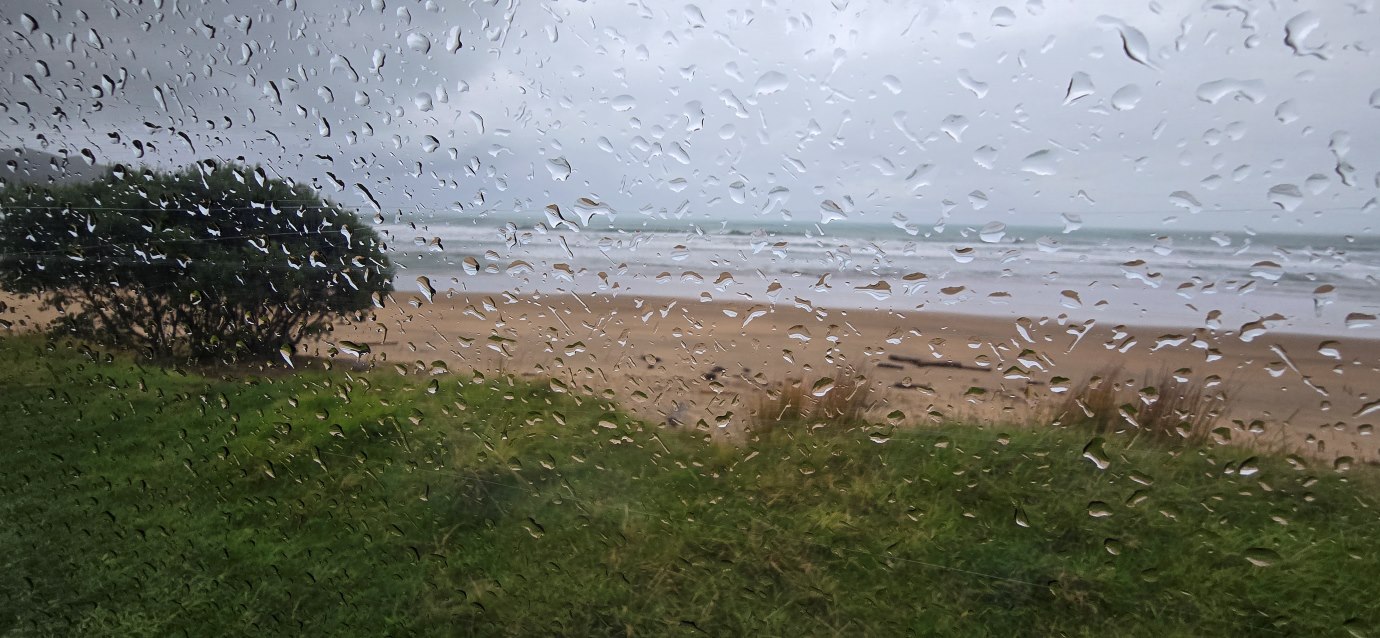
Our home for the night is beside the ocean at Kaiaua Beach – a campsite administered by the Gisborne District Council. Bookings are made online.
As at writing this, we’re one of only three freedom campers parked up here.
We have our tail into the approaching weather, listening to the wind and the ocean crash maybe (?) 100m away.
I’m looking forward to the sunrise – if the sky clears overnight – in the morning.

Here’s to exploring more of Godzone Aotearoa New Zealand…
Here’s to remembering to opening overhead lockers with caution after travel…
And here’s to our second night of freedom camping and powering my laptop on a 12v charger for the very first time.
Here’s to SmilingOnTheInside!
You must be logged in to post a comment.